


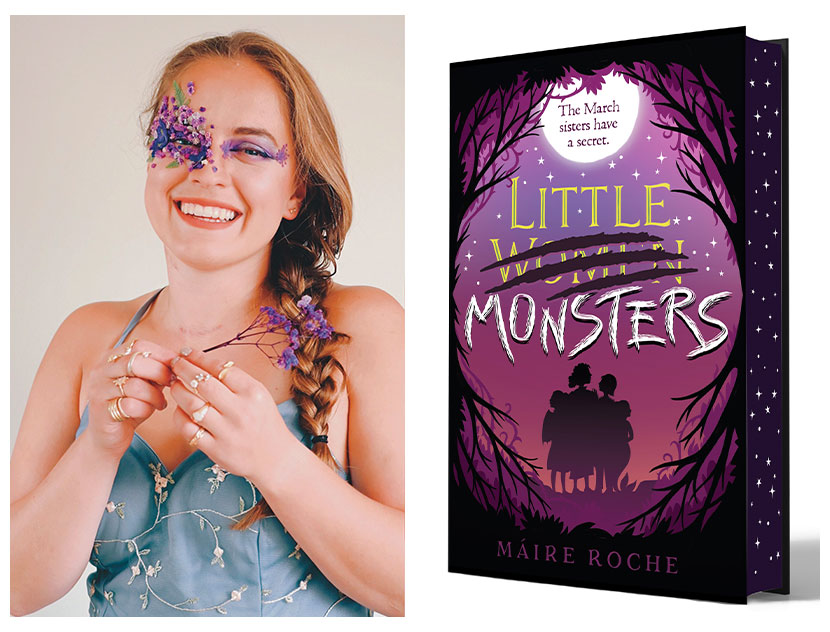
Classics are trending, and while we love a great Victorian novel, Victorian remixes are catching our eye this fall. Taking on the family dynamic of Louisa May Alcott’s March sisters in an all-new look at Little Women, Maire Roche asks readers to reconsider sisterhood and community in Little Monsters.
More than a Little Women-with-monsters take on the story (sorry, not sorry to Pride and Prejudice and Zombies fans), Maire transplants Meg, Jo, Beth, and Amy to modern-day Salem, Massachusetts, a “seam city” where the March sisters, their foster family, and the girls’ monstrous qualities aren’t the strangest things the town has ever seen, especially around Halloween. That doesn’t stop the sisters from struggling with fitting in and growing up, and before they know it, the entire town (friends and foes alike) is involved.
While the original novel focuses on Jo’s experiences over a lifetime of discovery and challenges, Little Monsters focuses more on Meg as the overly responsible older sister of four orphans trying to find their place in the world. Maire shared with us that Meg is a character she found was underappreciated, especially as an older sister carrying the expectations of society and her family on her shoulders. “That drew me to exploring Meg in the modern day, and what unfair challenges she might face (and be judged for).” In this remix, many of the struggles send Meg running down the hallways of her middle school, and marriage isn’t on the table, but concerns about money are still a major part of her experience.
What really stands out about Little Monsters is that despite being a story about four orphans, we don’t see a world that is out to get them. Many of the March sisters’ biggest challenges come from within. A monster hunt is spiraling through the town, but fitting in, finding compassion for each other, and learning to accept help are bigger challenges for the sisters than a lot of the bump-in-the-night drama that would normally pit our protagonists against their home.
Little Monsters is a found-community story. Maire explained that this was a big part of what she wanted for the March sisters if they were going to live in the present day. The March sisters have lived in Salem their entire lives, but it doesn’t seem like they’ve ever felt at home there. “Community is so, so important, and now more than ever all of us, both grownups and kids, are increasingly siloed. We live in single-family homes, away from our extended families and networks, we work so much that it’s hard to see the people we love, and we pay for services that used to just be part of community, like rides home and a meal delivered when you’re not feeling well and so many other things,” she said. “It was so important to me to write a story that reflected the type of community that can be so life-saving. For Meg, as a kid who has bounced between homes in foster care and had very little stable community, I especially wanted to show what community can and should be like. Meg discovers a world that is ready to accept her and her sisters, that shows up to support them when they need it, and cares for everyone on their block. May we all find community like Meg does.”
Every year, we talk about the coziness of fall and how it allows us to explore our own comfort, and Halloween is a playground for dressing up as our most fabulous or frightening selves. Little Monsters embraces this, and Maire wants her readers to see the place where community support and self-discovery intersect. “I hope young readers realize that no emotion or problem is too big to ask for help about,” she said, “that you deserve support and acceptance no matter how anxious (or ‘monstrous’) you feel—and of course that magic might be just around the corner.”
The little women are back and spookier than ever, and luckily for us, whether you’re ignoring the forecast and leaning into “Augtober” or just planning your fall TBR, Little Monsters is here just in time. Add it to your reading list! Little Monsters hits shelves on August 18, 2026.