


Conversations about the role mental health plays in athlete success are growing every year. Yet, while awareness of the impact athletics has on athletes is increasing, many of those conversations focus on impact sports like football, basketball, and soccer. We know that the pressure of performing well exists beyond the field or the court. It impacts anyone who decides to find the limits of their strength and push past them over and over again. Dancers are no exception to this delicate balance that comes with chasing big achievements.
Auti Kamal is a dancer and dance educator who learned the importance of knowing your limits when she had to confront her own career expectations. In college, Auti turned away from a career as a professional dancer to focus on teaching. That transition came from realizing that she was spending more time trying to match her peers’ goals than figuring out what she wanted. This led Auti to choreographer positions, teaching, and even her own digital classroom.
Recently, Auti returned to the pivot point that made her the dancer she is today with a different kind of project. Her program, The Elite Dancer’s Mind, is an online course aimed at what’s inside the dancer rather than what’s outside. She wants to reframe the idea that being “Elite” is only about physical strength and technique, so dancers can find value in their performance successes as well as their personal goals.
From a young age, many dancers are encouraged to specialize, and their performance and success often rely on being able to cope with physical and mental stress from a variety of sources, including their coaches, parents, and peers. It can be hard to separate competitive spirit from feelings of self-worth. This pressure is present when they’re in dance spaces, but for many dancers, those are their only spaces. In a survey of 58 undergraduate dance students at Chapman University in Orange, CA, researcher Samantha Sobash found that more than half of the participants (55.8%) said “the majority of their close friends are dancers,” and 29.6% share they were more comfortable interacting with dancers over non-dancers. This means for some, dance pressure can be constant.
Dancers in competitive spaces are driven. They are used to long studio hours and high expectations, the costs of which are often ignored until concerns like burnout, anxiety, and depression have an impact on performance. Not every dancer is after a professional career or even competitive success, but for those who are, dealing with mental health issues and what York University Professor of Psychology Dr. Robert T. Muller calls “neurotic perfectionism”—a condition where failure is based on effort and dancers compulsively say yes to new challenges—is common.
Auti recognizes these struggles and wants dancers to build on these conversations for their own benefit. Dancers need to build “discipline, self-respect, emotional strength,” but they also need to have a strong sense of self and the reason they’re dancing at all if they want to avoid associating dance with success only others can see. Otherwise, they could be facing the potential harm of athletics and missing out on the benefits. Dr. Muller says, “Athletes who base their success on the number of mistakes they make report higher anxiety, lower self-confidence, and higher rates of negative thinking 24 hours prior to competition.”
Elite dancers are much more than dancers who know how to avoid mistakes. We talked to Auti about her relationship to the mental health conversation and how she’s sharing strategies for preventing burnout with dancers of all ages.
Showstopper Magazine Online: Tell us about The Elite Dancer’s Mind.
The Elite Dancer’s Mind is an online course and digital workbook about what’s happening inside the dancer, not just what we see on stage. It’s a space where dancers can build self-awareness, confidence, emotional resilience, and a healthier relationship with themselves and their passion. Technique matters, of course, but your mindset is what carries you through the hard days, auditions, comparisons, and growth.
SMO: What does it mean to be an “Elite Dancer”?
Being an elite dancer isn’t about being perfect or being the “best” in the room. It’s about how you show up. It’s discipline, self-respect, emotional strength, and the ability to keep going while staying connected to your why. An elite dancer knows how to take care of their body and their mind.
SMO: You are no stranger to digital education… What inspired this program specifically?
I kept seeing the same thing over and over: dancers who were incredibly talented but were facing so much struggle internally. Anxiety, burnout, comparison, self-doubt. And there wasn’t really a space in dance training that addressed that in a consistent, supportive way. I wanted to create something accessible that dancers could return to again and again, something that meets them where they are.
SMO: What is your relationship with mental health and mental health practices?
Mental health is something I actively practice, not something I “arrived at.” It’s daily. Some days it looks like getting into an empty studio to move, some days it’s rest, some days it’s setting boundaries or being honest with myself. I really believe mental health is about learning how to listen to yourself and respond with care instead of pressure. As a former high-performance dancer and current mental health therapist, I have seen all sides of caring for a dancer’s mind.
SMO: What specific mental health needs do you think dancers have?
Dancers often deal with perfectionism, comparison, body image struggles, performance anxiety, and a fear of not being “enough.” There’s also a lot of pressure to push through pain, physically and emotionally. What dancers really need is permission to be human, along with tools to process what they’re feeling and move forward in a healthy way.
SMO: Realistically, what do you think most dancers need to do to maintain their health day to day?
It’s the small things. Checking in with yourself. Getting enough rest. Fueling your body. Taking breaks without guilt. Being mindful of your self-talk. And honestly, having support. You don’t have to do everything alone, even though dance culture sometimes makes it feel that way. The dance friends and teachers you have in your circle, the social media content you absorb, and the types of dance events you attend matter. Everything feeds into mental health and how you view yourself as a dancer.
SMO: How does The Elite Dancer’s Mind target these needs?
The program gives dancers structure and guidance around things that usually feel overwhelming or abstract. It breaks mental health down into short, doable practices, like reflection prompts, mindset shifts, grounding tools, so it’s not just “think positive,” it’s here’s how you actually work through this. The course and workbook are built to fit into a dancer’s busy schedule, making mental health care sustainable and fun.
SMO: What should dancers expect from work like this?
Honesty. Growth. Some discomfort, but the kind that leads somewhere meaningful. It’s not about quick fixes, it’s about building a deeper relationship with yourself. Dancers can expect to feel more grounded, more confident, and more in control of how they respond to challenges. Dancers will finish the course and workbook knowing more about who they are and the value they hold in the dance world.
SMO: What are your top tips for developing physical and mental strength?
Consistency over intensity. Rest is part of training. Pay attention to how you talk to yourself. And remember that strength isn’t just pushing harder, it’s knowing when to pause, adjust, and take care of yourself so you can keep going long-term.
SMO: Is this course only for dancers, or will others in the dance world find it useful?
It’s designed for dancers, but honestly, anyone in the dance world—teachers, choreographers, even parents—can benefit. Understanding the psychological side of dance changes how you support yourself and others. There’s way more to being a high-level dancer than just working on technique and performance skills.
SMO: Grounded mental health activities are hyper-relevant today. How has The Elite Dancer’s Mind evolved to respond to those conversations?
I’ve really focused on making the work practical and accessible. Less about big concepts, more about what you can do in real moments before class, after rehearsal, during stressful times. It’s about meeting dancers in their actual lives, not just ideal situations. Mental health can feel like such a big concept, so it felt important to me to create a program that flows into a dancer’s day-to-day, something you can move through at your own pace.
SMO: Is there anything else you’d like to share?
Just that you don’t have to earn rest, confidence, or self-worth through achievement. You’re already allowed to take up space, to grow, to struggle, and to keep going. Dance is such a beautiful practice of continuously falling and getting back up, expanding your comfort zone, and learning more about yourself. And in the midst of growing and working toward big dreams, remember: you are already whole, exactly as you are right now.
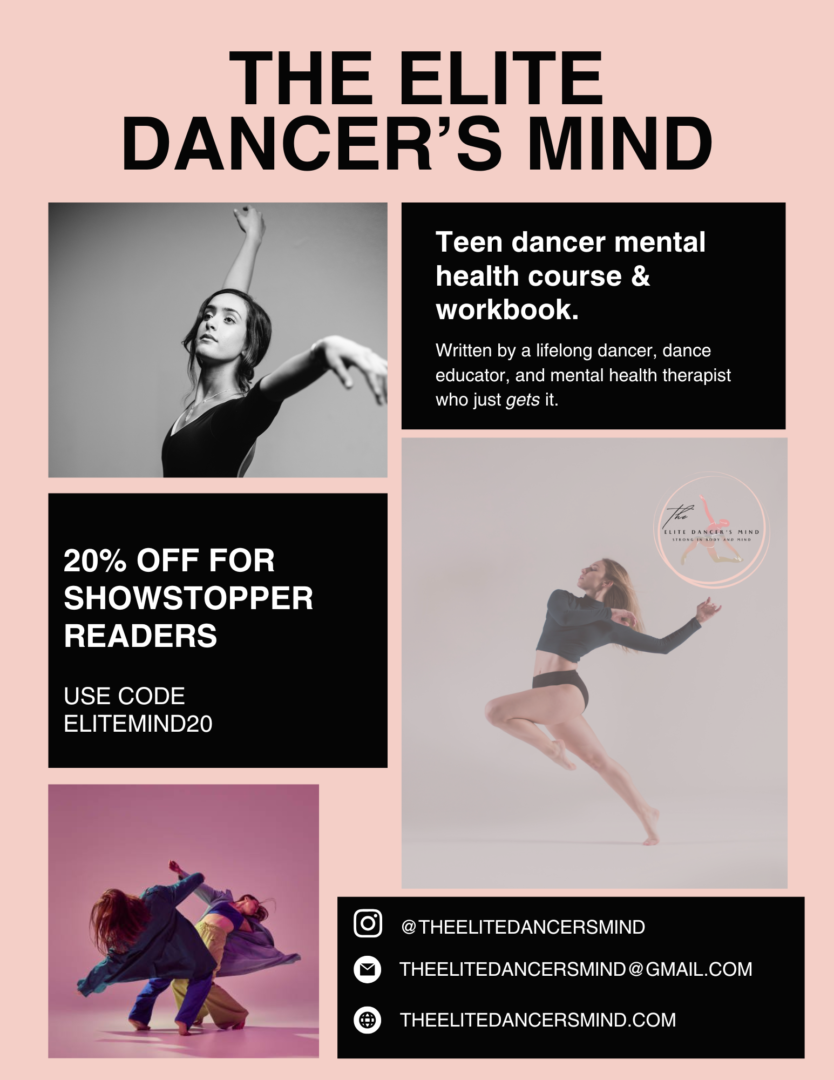
Auti is offering a discount for Showstopper Magazine Online readers who want to try The Elite Dancer’s Mind! Use the code ELITEMIND20 at checkout for 20% off. (Showstopper and Showstopper Magazine do not receive commission, compensation, or money for sharing this discount code.)